
Electric Water Heater Repair in Elkhorn, NE
An electric tank has no flame, no flue and no pilot. It has two elements, two thermostats, a safety cut-out and a set of terminals — and almost every fault is one of those six things.
Call (402) 897-1841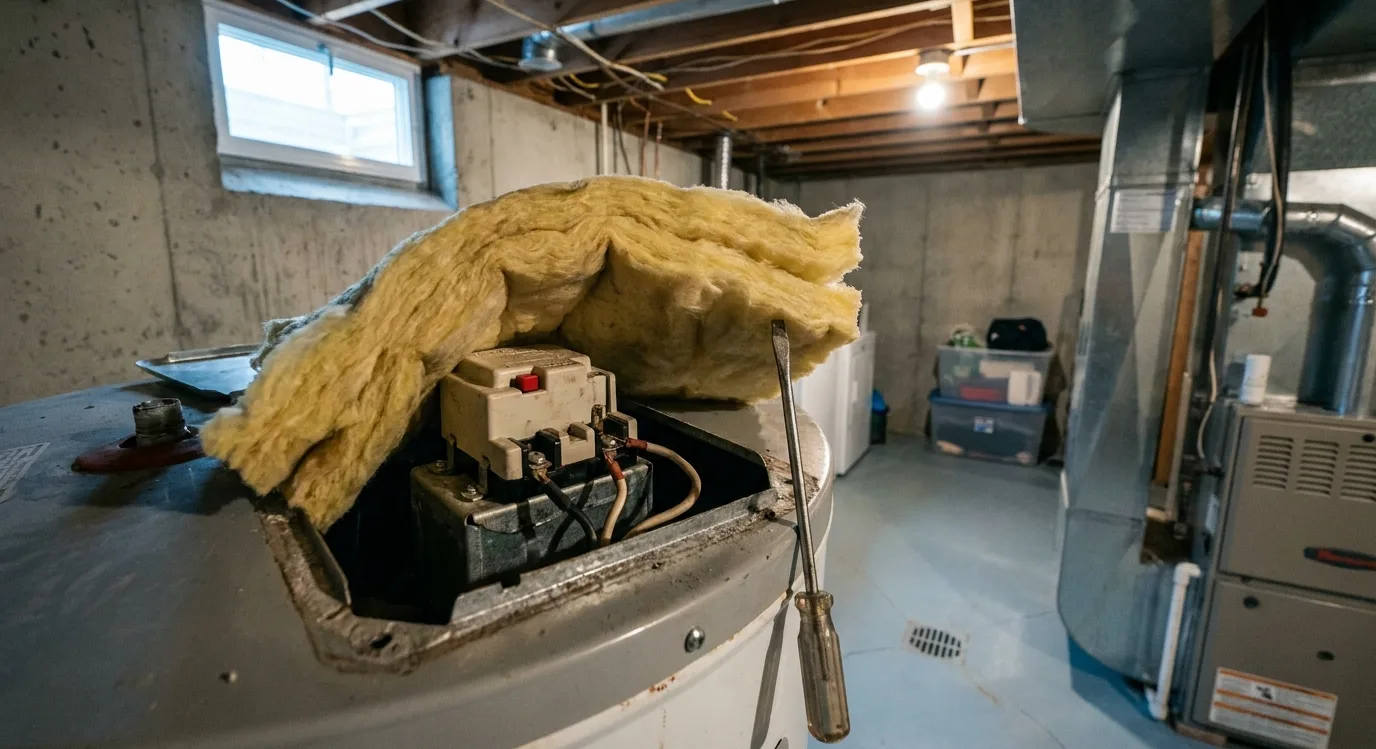
What actually fails, and how you can tell
Upper heating element
When the top element goes, you get no hot water at all. The upper thermostat will not hand control down to the bottom of the tank until the top of it is up to temperature, so the whole unit stalls.
Lower heating element
The signature is a short supply: genuinely hot water for a few minutes and then cold. The top of the tank heats, the bottom never does.
High-limit / ECO switch
The red reset button on the upper thermostat. It trips when tank temperature runs away. Resetting it once is reasonable; a second trip means something else is wrong and needs finding.
Thermostats
Contacts that weld shut give scalding water; contacts that fail open give none. Both are cheap parts and both are easy to confirm with a meter.
Burnt or loose terminals
Discoloured, blackened connections at the element or thermostat. A loose connection heats up, oxidises, heats more, and eventually chars the insulation. This is a fire risk, not just a fault.
Scaled-over elements
In hard water an element can armour itself in a thick mineral shell. It still passes a continuity test but transfers very little heat, so the tank never quite gets there.
Tested under load, not guessed at
A continuity check across a cold element tells you only that the wire inside is unbroken. It says nothing about whether the element is doing useful work. We measure resistance, check it against the element's rated wattage, and confirm actual current draw with the unit calling for heat.
That is the difference between replacing the part that failed and replacing both parts because one of them might have. You should not be paying for a component that tested fine.
The mistake that turns a small job into a new heater
If a tank is drained, or the water level drops below an element while power is still on, the element fires into air and destroys itself — often in well under a minute. It is called dry-firing, and it is the most common way a straightforward situation becomes an expensive one.
So the order matters: kill the breaker first, then touch the water. Every time. It is the first thing Water Heater Repair Elkhorn does on an electric call and the one habit worth copying, including when you are only draining the tank to check something.
Frequently asked questions
Can I change an element myself?
People do. The parts that catch them out are a seized element that shears in the fitting, a drained tank re-energised too early, and 240 volts at the terminals. Kill the breaker and verify it is dead before anything else.
Why does my breaker keep tripping?
Usually a shorted element or water that has found its way into the element gasket or the thermostat pocket. Do not keep resetting it — that is a fault asking to be found, not a nuisance trip.
Are 240V elements interchangeable?
Only by voltage, wattage, length and fitting type. A 4500W element in a tank wired for 3800W, or a long element in a short tank, causes its own set of problems.